
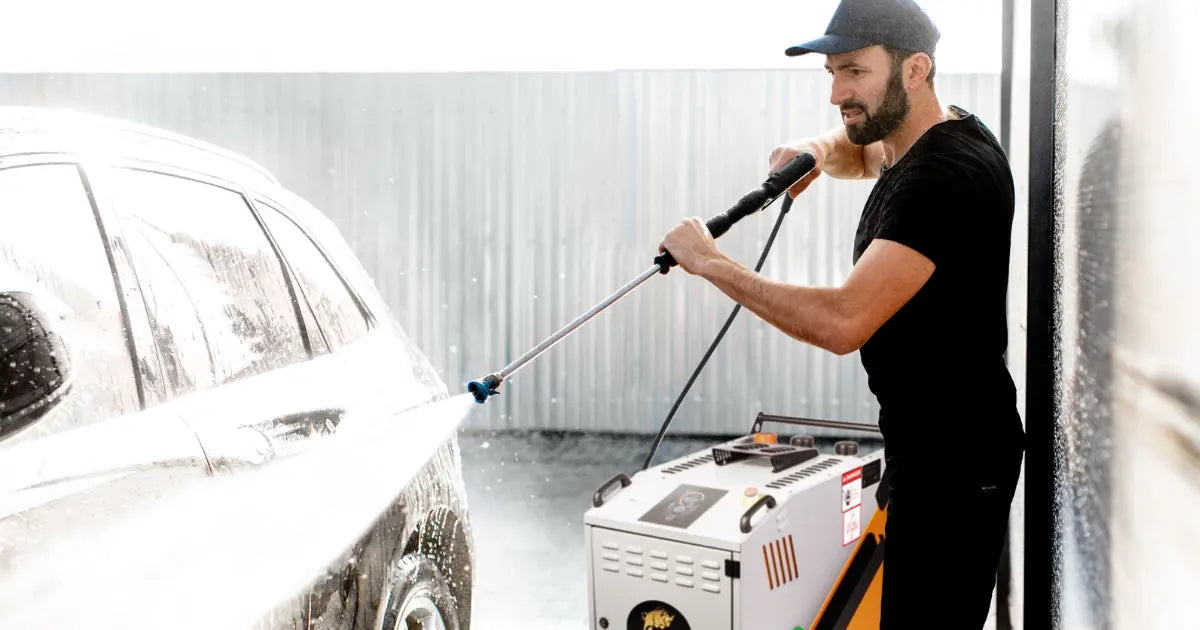
Generator or Battery Power for Mobile Detailing: What Will Run Your Equipment?
Mobile detailers need reliable power wherever a customer’s vehicle is parked. The right setup depends on your machine, the other equipment you use, and how long you need to work before refuelling or recharging.
A generator can be a practical choice for longer jobs and higher electrical loads. A battery power station can suit shorter jobs or locations where you want quieter operation. Before choosing either, check the voltage, phase, and power requirements of your exact machine.
Start with your equipment’s power requirements
Make a list of everything you may run at the same time:
- Steam cleaner
- Vacuum or extractor
- Lights and charging equipment
- Any other powered accessories
Add the running wattage of the equipment you’ll use together. Also check startup requirements: a vacuum motor, for example, may briefly draw more power when it starts. When comparing generators, look at the continuous rated output, not only the maximum or peak wattage.
Voltage and phase matter too. A power source can have enough watts and still be unsuitable if it does not match your machine’s electrical requirements. Check the machine’s rating plate and manual before selecting a generator or battery inverter.
When a generator makes sense
A generator may suit a mobile detailing business that runs longer jobs, works at several locations in one day, or uses equipment with a high electrical load. Its output must support the equipment you plan to run at the same time, including any startup demand.
Fortador machine power needs vary by model. The Volt Mini is listed at 1,650 W. The Volt Electra is listed at 5.5 kW, and the fully electric Pro Max Electra has a listed consumption range of 3–11 kW. These figures are model-specific, so check the technical documentation for the exact machine and configuration before choosing a generator. www.fortador.com
A fuel-powered generator also needs a safe location outdoors, away from doors, windows, and vents. Plan where it will sit before a job so its exhaust does not enter the vehicle or a nearby building. www.cpsc.gov
When battery power may suit your work
A battery power station can be useful for shorter jobs or locations where generator noise may be a concern. Check both its continuous power output and its usable battery capacity. The inverter must be able to supply the machine’s required watts and voltage, while the battery must store enough energy for the time you plan to work.
Use this estimate to get a rough idea of runtime:
Estimated runtime (hours) = usable battery capacity (kWh) × inverter efficiency ÷ average equipment load (kW)
For example, a 2 kWh battery delivering 90% of its stored energy, running a 1.65 kW load, gives an estimated runtime of about 1.1 hours. This is an illustration, not a guaranteed runtime. Actual results depend on the equipment’s operating cycle and anything else connected to the battery.
If your workday involves several vehicles, consider how long you’ll need between charges and whether the battery can meet the load throughout the job.
Consider the type of Fortador machine
Fortador offers plug-in electric and diesel-hybrid machines, and their power needs differ. For example, Fortador lists 650 W plus 1,150 W for the vacuum on certain diesel-hybrid Pro Max variants. The fully electric Pro Max Electra has a different power requirement. Check the specifications for your exact model rather than assuming that machines with similar cleaning functions need the same power setup. www.fortador.com
When comparing options, ask:
- What is the machine’s rated power requirement?
- What voltage and phase does it need?
- Will the vacuum, extractor, or other equipment run at the same time?
- How long is a typical job?
- Can the generator or battery supply the required output for that whole period?
Plan for a real workday
Write down the equipment you use, its power requirements, and how long each item runs during a typical job. Then compare the total demand with the generator’s continuous output or the battery system’s output and usable capacity.
The best setup is the one that matches your Fortador machine and your working routine. If you’re unsure which power source is suitable, check the machine’s rating plate and manual, then ask the Fortador team to review your equipment list.
Need help planning a mobile detailing setup? Contact Fortador with your machine model, location, and list of equipment. Our team can help you review the configuration and arrange a demonstration around your application.

Αφήστε ένα σχόλιο
Αυτή η τοποθεσία προστατεύεται από το hCAPTCHA και ισχύουν η Πολιτική απορρήτου και οι Όροι Παροχής Υπηρεσιών του hCaptcha.